


Contact centers use AI to automatically detect and classify pharmacist transfers in call transcripts, revealing which escalations are unnecessary. This allows teams to coach frontline agents, reduce avoidable transfers, and protect pharmacist capacity for true clinical needs.
TL;DR
-
AI analyzes recorded calls at scale
-
Transfers to pharmacists are automatically detected and categorized
-
Unnecessary escalations are surfaced in a focused report
-
Leaders use the insight to coach agents, refine processes, and reduce cost
-
Pharmacists spend more time on clinical work, not administrative calls
Pharmacists are one of the most valuable resources in any pharmacy operation. Their time is limited, highly specialized, and expensive. Yet in many pharmacy contact centers, pharmacists spend a surprising amount of time handling calls that don’t require clinical expertise, including delivery status questions, insurance clarifications, billing issues, and prior authorizations.
While those are all important conversations, they don't require a pharmacist and are better suited to trained sales reps. But the problem is a complete lack of visibility. Without clear insight into why calls are being transferred and who is making those transfer decisions, contact center leaders are left guessing where specialist time is being lost and how to fix it without disrupting the process and introducing more risk.
Over the last 15 years, we have helped hundreds of mid- to large-sized contact centers worldwide across dozens of industries to turn contact center data into actionable insights, resulting in better customer experience, increased revenue, and lasting competitive advantages. In this article, I want to walk you through an example of how contact center AI helps you do exactly that. By the end of the article, you will know what to expect as an outcome and how it is achieved in MiaRec.
The Problem: When Escalation Becomes The Default
In specialty and facility pharmacy environments, frontline representatives act as the first point of contact. Their role is to resolve issues wherever possible before escalating to a pharmacist, because pharmacists are a specialty resource that should only be brought into the loop when their expertise is required.
But in reality, this is what happens a lot:
-
A caller asks to speak to a pharmacist,
-
A less experienced rep transfers the call without clarifying the reason,
-
The pharmacist ends up handling a non-clinical issue, and
-
The frontline rep never gets coached, because the behavior isn’t visible.
Over time, this creates operational friction:
-
Pharmacist queues fill up with administrative work,
-
True clinical calls wait longer,
-
Costs rise without improving care quality, and
-
Coaching becomes reactive instead of targeted.
When pharmacy teams review transfer data manually, they often discover that a large portion of pharmacist escalations are driven by issues such as:
-
Delivery status inquiries,
-
Insurance or paperwork questions,
-
Billing or payment clarifications,
-
Prior authorization follow-ups, and
-
General “Can you check on this?” requests.
The issue isn’t that transfers happen. It’s that unnecessary transfers go undetected. The problem is that, without structured insight, all transfers look the same.
The Solution: Invalid Transfer Reports That Create Full Operational Visibility
One way to improve operational visibility (and therefore protect your specialist resources) is to use Invalid Transfer Reports. These daily reports change how pharmacy contact centers understand and manage pharmacist escalations. Instead of relying on anecdotal feedback, random call sampling, or assumptions about why pharmacists are overwhelmed, leaders receive a clear, structured report that shows exactly when unnecessary transfers occur, why they happen, and who is making them.
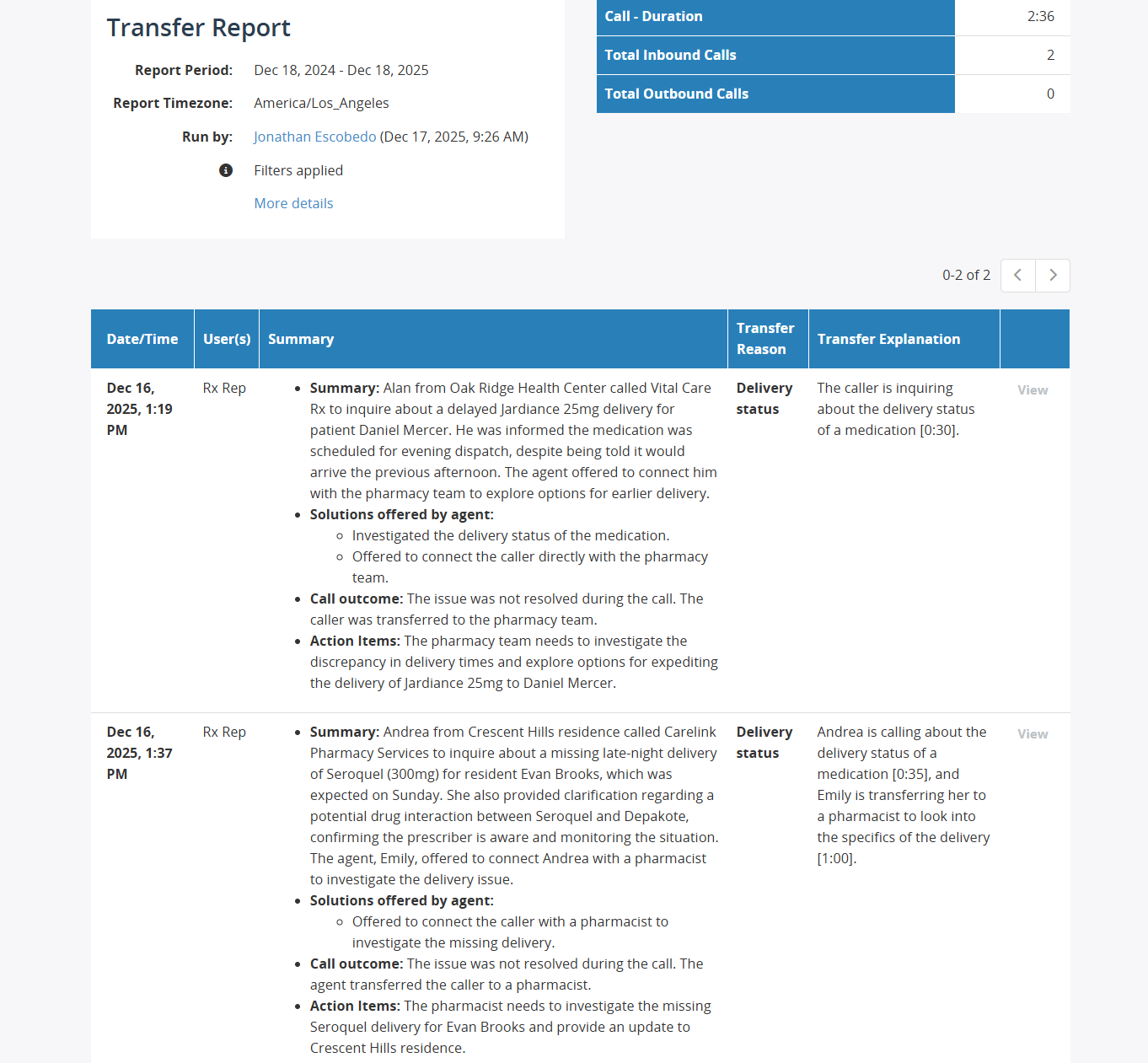
Image: Screenshots of an Invalid Transfer Report created by MiaRec
Each report consolidates the calls that the AI has flagged as invalid transfers (based on your specific definition) into a single, focused view. For every flagged transfer, teams can see the transfer reason extracted directly from the conversation, the department the call was routed to, and a concise summary based on the transcript. Because this is evidence-based, there is no need to replay entire calls to understand context, as all ambiguity is removed. The insight is already there, consistent across every interaction, and updated continuously as new calls come in.
Operationally, this creates a very different reality. Coaching is no longer reactive and generic but becomes precise and grounded in real examples and situations. Leaders can see patterns across agents, shifts, or call types and address them systematically. Frontline reps gain clarity on when to escalate and when not to. Pharmacists spend less time answering delivery or billing questions and more time focused on actual clinical needs. Over time, the organization moves from managing escalation volume to actively shaping escalation behavior, reducing cost, improving response times, and protecting specialist capacity without compromising care quality.
How To Achieve This In MiaRec Step By Step
MiaRec turns customer calls and contact center data that is otherwise inaccessible at scale automatically into actionable insights. For example, pharmacy contact centers can configure MiaRec to automatically surface unnecessary pharmacist transfers and turn them into beneficial information you can quickly act upon. Here is how it is done — and it only takes a few minutes:
Step 1: Navigate to MiaRec Speech Analytics in the Admin Console
Start in the MiaRec Admin Console and access Speech Analytics. This is where AI Tasks and Custom Insights are configured. Speech Analytics allows you to define exactly what the AI should look for in conversations — based on your operational rules, not generic assumptions.
Step 2: Create an AI Task to detect transfer events
Next, create a new AI Task focused on call transfers.
The goal of this task is simple:
-
Analyze the full call transcript,
-
Identify whether the call resulted in a transfer,
-
Extract why the transfer occurred, and
-
Identify where the call was transferred.
To do this, you define a structured prompt that instructs the AI on what to extract from each conversation. It could look something like this:
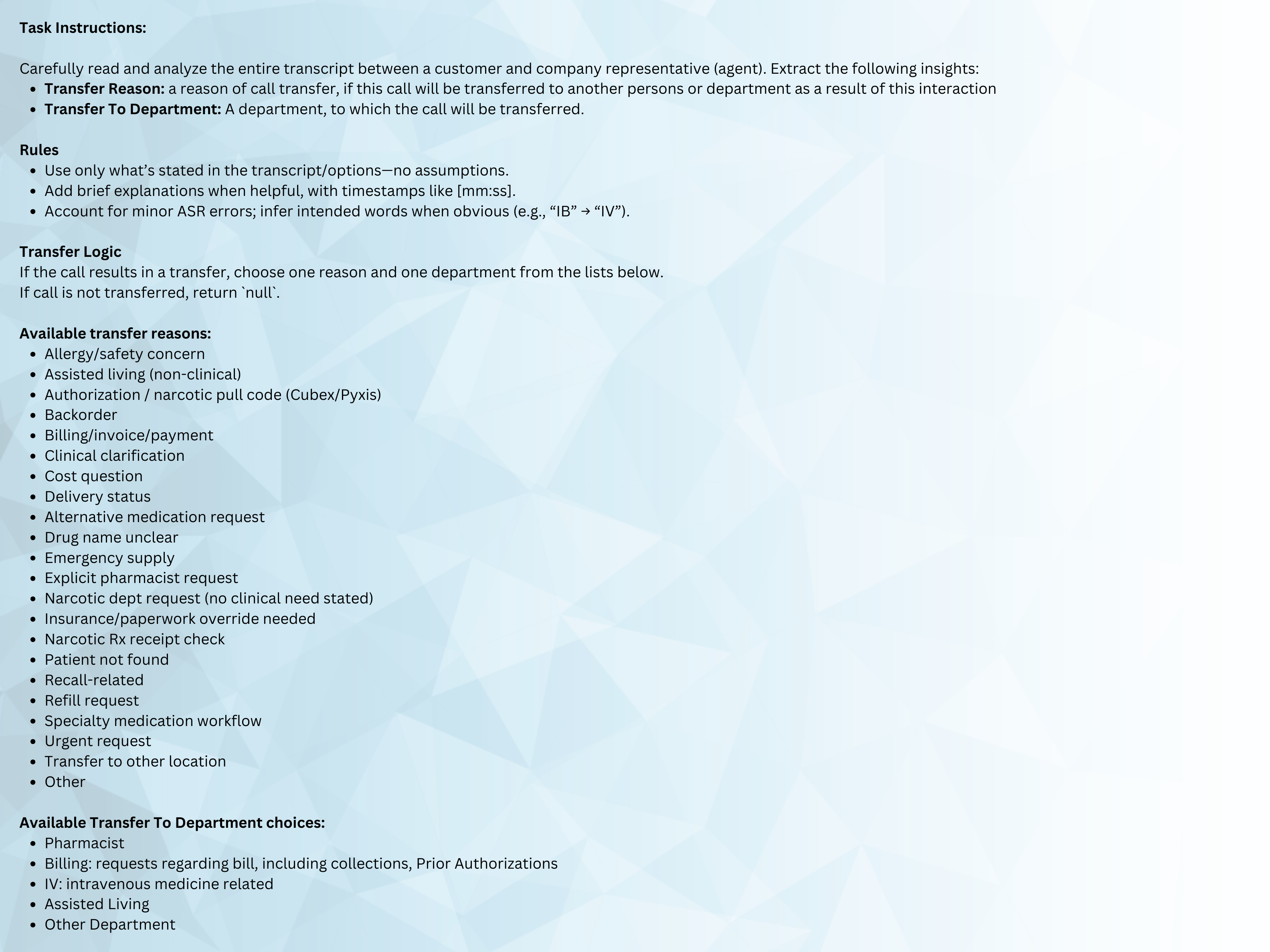
Image: Transfer Insight Prompt example to create an AI Task within MiaRec to identify all invalid transfers within a pharmacy contact center.
In this case, the task is configured to extract two things:
-
Transfer Reason – the reason stated in the conversation for the transfer and
-
Transfer To Department – where the call was transferred (for example, pharmacist)
The prompt explicitly instructs the AI to:
-
Use only what is stated in the transcript
-
Avoid assumptions
-
Handle minor transcription errors
-
Return
nullif no transfer occurred
This ensures the output is consistent, auditable, and safe to use in regulated environments.
Step 3: Define allowed transfer reasons and departments
One of the most important steps is defining your own list of transfer reasons. These should be specific to your organization. In MiaRec, you can specify a controlled set of categories, such as:
-
Delivery status
-
Billing / invoice / payment
-
Insurance or paperwork override
-
Clinical clarification
-
Explicit pharmacist request
-
Refill request
-
Emergency supply
-
Specialty medication workflow
This matters because it allows you to distinguish between:
-
Transfers that are expected and appropriate
-
Transfers that are inappropriate and require additional coaching or signal process gaps
Notice how you are not asking the AI to decide what’s right or wrong, but rather you are asking it to classify what happened, based on rules you define.
Step 4: Run the AI Task across your call data
Once the task is configured, MiaRec automatically runs it across your call recordings. For each call, the AI determines: Was there a transfer? If yes: What was the stated reason? And which department received the call? This happens at scale, without manual review. At this point, you already have structured data that would typically take hours or even days to compile by hand.
Step 5: Filter for unnecessary pharmacist transfers
Now comes the critical step: filtering out the unnecessary transfers.
Using MiaRec’s reporting and filtering capabilities, you can isolate:
-
Transfers to pharmacists
-
The reasons that certain transfers should have been handled by frontline reps
Instead of reviewing every transfer, you focus only on the subset that signals wasted specialist time. This prevents data overload and keeps attention where it matters.
Step 6: Generate a focused transfer report
The output of this setup is an Invalid Transfer Report (see first screenshot above) that shows:
-
When transfers occurred,
-
Which agents made the transfer,
-
Why the transfer happened, and
-
Where the call was sent.
Each entry includes:
-
A short call summary,
-
The extracted transfer reason,
-
The transfer destination, and
-
A timestamped explanation grounded in the transcript.
This report becomes your daily dose of operational insights. You no longer rely on anecdotal feedback or random call sampling. Instead, you can see clear patterns.
What this gives you in practice
With this level of visibility, pharmacy leaders can finally answer questions like:
-
Which transfer reasons drive the most pharmacist workload?
-
Are certain reps escalating more often than others?
-
Are specific shifts, locations, or call types creating friction?
-
Are coaching efforts actually reducing unnecessary transfers over time?
More importantly, this insight is actionable. Once unnecessary transfers are visible, teams can respond deliberately instead of reactively. Common actions include:
-
Coaching reps on how to handle specific call types
-
Updating scripts or knowledge base content
-
Adjusting call routing rules
-
Clarifying when pharmacist escalation is required
-
Measuring improvement week over week
Because the data is structured and repeatable, you can track whether changes are working — not just assume they are.
Fully Supported, Deeply Customizable, & Designed To Adapt To Your Business
While this article focuses on reducing unnecessary pharmacist transfers, the underlying capability is far more flexible. MiaRec’s onboarding team works with you to define what matters in your conversations, configure AI Tasks, and validate the results.
This guidance is grounded in more than 15 years of experience across hundreds of customers and dozens of industries. We have seen how different organizations translate conversation data into operational improvements, better customer experiences, and measurable business outcomes. Even though the platform is simple to configure, you are never left on your own. We help you think through the criteria, edge cases, and reporting structures that make insights stick.
Just as importantly, everything is fully customizable. Prompts, categories, and reports are built around your business rules. If you can describe what you want to detect in a conversation, MiaRec can help you surface it consistently at scale.
What this approach can be used for — across industries
Teams are already applying this same approach to uncover insights such as:
-
Recovering missed revenue in hotel reservation calls
-
Improving guest experience at check-in by passing preferences and context from reservation calls to front-desk teams
-
Reducing compliance risk for regulated sellers by flagging sensitive topics, unclear promises, or policy exceptions
-
Identifying critical incidents in home care and healthcare without reviewing every call manually
-
Optimizing specialist utilization by detecting unnecessary escalations across any department
-
Improving frontline coaching by highlighting repeat patterns tied to specific reps, shifts, or call types
-
Surfacing product friction that customers struggle to articulate in surveys
-
Detecting early churn or dissatisfaction signals before they show up in KPIs
-
Feeding real customer language into product and CX teams to drive improvements
-
Testing new processes or scripts and measuring their impact in real conversations
As long as customers are calling in and those conversations are recorded, MiaRec's AI can help turn them into structured, actionable insights.
See What Is Possible: Schedule Your Demo Today
If you’re wondering how this could apply to your own operation, schedule a demo with us for a collaborative discussion, not just a sales pitch, to focus on your contact center goals.

5 Value-Adding Conversation Intelligence Use Cases for Contact Centers

Call Types: Unlocking VOC Insights with AI-Driven Call Categorization